Monday, 5 November 2007

Robert Williams on Lowbrow art
http://beinart.org/info/essays/robert-williams.php
In 1979 Gilbert offered to do an art book of all my paintings. No other publishing company anywhere would dare to undertake such an unorthodox project. It was decided at that time, since no authorized art institutions would recognize this form of art, to call my book The Lowbrow Art of Robt. Williams.
There was never any intention to make the title of my book the name of a fledging art movement but, over time, that seems to be what has transpired. The original connotation was to suggest that this self-deprecating name would, over a matter of time, rise from the lowest cultural phylum of art to ironically (and much to the consternation of the art world) climb to the top–but this wasn’t a serious conjecture.
In 1979 Gilbert offered to do an art book of all my paintings. No other publishing company anywhere would dare to undertake such an unorthodox project. It was decided at that time, since no authorized art institutions would recognize this form of art, to call my book The Lowbrow Art of Robt. Williams.
There was never any intention to make the title of my book the name of a fledging art movement but, over time, that seems to be what has transpired. The original connotation was to suggest that this self-deprecating name would, over a matter of time, rise from the lowest cultural phylum of art to ironically (and much to the consternation of the art world) climb to the top–but this wasn’t a serious conjecture.
Tuesday, 23 October 2007
that article that gary baseman refers to...
http://www.laweekly.com/news/features/pictures-from-the-unibrow-revolution/179/
Thursday, 11 October 2007
"Pervasive"
adjective FORMAL
present or noticeable in every part of a thing or place:
The influence of Freud is pervasive in her books.
A pervasive smell of diesel.
Reforms are being undermined by the all-pervasive corruption in the country.
present or noticeable in every part of a thing or place:
The influence of Freud is pervasive in her books.
A pervasive smell of diesel.
Reforms are being undermined by the all-pervasive corruption in the country.
Gary Baseman
Below is a quote from Crowndozen.com about Baseman.
"No single person has done more to help define, progress and legitimize the current movement towards accessible art than Gary Baseman. He has left his mark upon an amazing variety of mediums, from the Emmy Award winning Teacher's Pet animated series and subsequent feature film to commercial illustration for corporate heavies like Nike, Chili's and Mercedes-Benz. His 'Dumb Luck' designer vinyl toy (produced by Critterbox) has taken the collectible market by storm, selling out left and right, leading to several other toy concepts in development. Amidst all that, he's still made time for internationally staged solo and group gallery shows, contributed illustration work to Rolling Stone, The New Yorker and Time magazines and compiled and released a 350+ page book showcasing his work. He also coined the term 'Pervasive Art' and has remained on the cutting edge of this movement, helping to foster it's growth and contextualize it within the contemporary art world.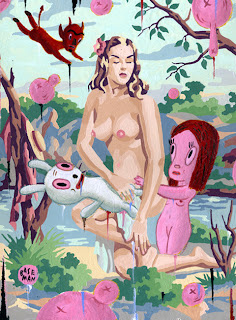 "
"
 "
"Thursday, 20 September 2007
Dictionary definition of lowbrow.
"One having uncultivated tastes."
"A person who is uninterested in intellectual pursuits."
"Characteristic of a person who is not cultivated or does not have intellectual tastes."
"A person who is uninterested in intellectual pursuits."
"Characteristic of a person who is not cultivated or does not have intellectual tastes."
Art that sells well.
http://www.everything2.com/index.pl?node_id=1662296
Quote;
"A movement to make art lacking highly cultivated and intellectual tastes acceptable."
Quote;
"A movement to make art lacking highly cultivated and intellectual tastes acceptable."
Another interesting article
http://www.artbabyart.com/lowbrowart.html
Quote;
"That is why I believe that making art for the sake of beauty is a form of denial, and labeling a picture "Lowbrow" is an attempt to ignore your inability to comprehend ones own primordial fear. "
Quote;
"That is why I believe that making art for the sake of beauty is a form of denial, and labeling a picture "Lowbrow" is an attempt to ignore your inability to comprehend ones own primordial fear. "

Another definition...
Lowbrow. With its origins in 1960's hot rod culture and underground comics, Pop Surrealism has evolved into a vilified, vital, and exciting art movement. It has been created from the marriage between surrealism and pop. An art that defines it’s own new Genre, but has not yet received a single unified name.
Art History 101
Lowbrow is a movement - slowly gaining momentum - that doesn't necessarily care if The Art World recognizes it as such. What matters to Lowbrow is that most of us average people do recognize it. Anyone who has ever watched cartoons, read Mad magazine, enjoyed a John Waters film, consumed a product with a corporate logo or possessed a sense of humor shouldn't have a hard time getting comfy with Lowbrow.
Lowbrow-the-Movement has here been assigned a "circa" of 1994, as that is the year that Lowbrow artist extraordinaire Robert Williams founded Juxtapoz magazine. Juxtapoz showcases Lowbrow artists and is currently the second best-selling art magazine in the U.S. (This seems like a good time to mention, too, that Williams claims copyright on the word "Lowbrow." As both pioneer and current grandee of the movement, he is certainly entitled.)
The roots of Lowbrow, however, go back decades to Southern California hotrods ("Kustom Kars") and surf culture.
Ed ("Big Daddy") Roth is frequently credited with getting Lowbrow, as a movement, underway by creating Rat Fink in the late 1950s. During the 60's, Lowbrow (not known as such, then) branched out into underground Comix (yes, that is how it is spelled, in this context) - particularly Zap and the work of R. Crumb, Victor Moscoso, S. Clay Wilson and the aforementioned Williams.
Over the years, Lowbrow has unapologetically picked up influences from classic cartoons, 60's TV sitcoms, psychedelic (and any other type of) rock music, pulp art, soft porn, comic books, sci-fi, "B" (or lower) horror movies, Japanese anime and black velvet Elvis, among many other "subcultural" offerings.
Is Lowbrow a legitimate movement?
Well, The Art World seems to get to decide these things. Time will tell. It's worth noting, however, that The Art World didn't cotton to many movements when they first emerged. The Impressionists endured years of lampooning by art critics - many of whom probably went to their graves kicking themselves black and blue for not buying early Impressionist works.
Similar stories exist about Dada, Expressionism, Surrealism, Fauvism, the Indian River School, Realism, the Pre-Raphaelite Brotherhood...aw, gee whiz. It'd be easier to list the times The Art World got in on the ground floor of a movement, wouldn't it?
If the test of time for legitimacy (as an artistic movement) means that Lowbrow speaks/spoke, in visual terms, to the millions of us who share a common cultural, symbolic language - albeit a "lower" or "middle" class, media-driven language - then, yes, Lowbrow is here to stay. Anthropologists will probably study Lowbrow in the future, to attempt to figure out late 20th and early 21st U.S. societal influences.
What are the characteristics of Lowbrow?
Lowbrow was born of underground or "street" culture.
The single most common tactic that Lowbrow artists employ is to poke fun at convention. They know the "rules" of art, and consciously choose not to abide by them.
Lowbrow art has a sense of humor. Sometimes the humor is gleeful, sometimes it's impish and sometimes it's born of sarcastic comment, but it is always present.
Lowbrow draws heavily on icons of popular culture, particularly those now commonly known as "Retro." Tail-end "Baby Boomers" will recognize them straight away, unless said Boomers were raised in an environment that disallowed outside influences.
Lowbrow, while it is defining itself, goes by a number of aliases: underground, visionary, Neo-Pop, anti-establishment and "Kustom" are but several examples. Additionally, John Seabrook has coined the phrase "Nobrow," and one has also seen the term "Newbrow."
For the time being, most Lowbrow art isn't sanctioned by the critical/curatorial/gallery-going mainstream. The few exceptions to this seem to be happening primarily in the greater Los Angeles area, with a smattering of southern Florida exhibitions thrown in. Juxtapoz magazine is the best bet for becoming acquainted with Lowbrow artists.
Lowbrow currently suffers something of an identity crisis, due to having a wide variety of artists lumped into it. For example, the designer of a simple, kitschy decal may be accorded the same Lowbrow designation as the artist who composes a technically masterful Lowbrow painting or sci-fi sculpture. Hopefully, this will sort itself out in years to come. Meanwhile, you might want to begin collecting Lowbrow now, for the sakes of your grandchildren.
Lowbrow-the-Movement has here been assigned a "circa" of 1994, as that is the year that Lowbrow artist extraordinaire Robert Williams founded Juxtapoz magazine. Juxtapoz showcases Lowbrow artists and is currently the second best-selling art magazine in the U.S. (This seems like a good time to mention, too, that Williams claims copyright on the word "Lowbrow." As both pioneer and current grandee of the movement, he is certainly entitled.)
The roots of Lowbrow, however, go back decades to Southern California hotrods ("Kustom Kars") and surf culture.
Ed ("Big Daddy") Roth is frequently credited with getting Lowbrow, as a movement, underway by creating Rat Fink in the late 1950s. During the 60's, Lowbrow (not known as such, then) branched out into underground Comix (yes, that is how it is spelled, in this context) - particularly Zap and the work of R. Crumb, Victor Moscoso, S. Clay Wilson and the aforementioned Williams.
Over the years, Lowbrow has unapologetically picked up influences from classic cartoons, 60's TV sitcoms, psychedelic (and any other type of) rock music, pulp art, soft porn, comic books, sci-fi, "B" (or lower) horror movies, Japanese anime and black velvet Elvis, among many other "subcultural" offerings.
Is Lowbrow a legitimate movement?
Well, The Art World seems to get to decide these things. Time will tell. It's worth noting, however, that The Art World didn't cotton to many movements when they first emerged. The Impressionists endured years of lampooning by art critics - many of whom probably went to their graves kicking themselves black and blue for not buying early Impressionist works.
Similar stories exist about Dada, Expressionism, Surrealism, Fauvism, the Indian River School, Realism, the Pre-Raphaelite Brotherhood...aw, gee whiz. It'd be easier to list the times The Art World got in on the ground floor of a movement, wouldn't it?
If the test of time for legitimacy (as an artistic movement) means that Lowbrow speaks/spoke, in visual terms, to the millions of us who share a common cultural, symbolic language - albeit a "lower" or "middle" class, media-driven language - then, yes, Lowbrow is here to stay. Anthropologists will probably study Lowbrow in the future, to attempt to figure out late 20th and early 21st U.S. societal influences.
What are the characteristics of Lowbrow?
Lowbrow was born of underground or "street" culture.
The single most common tactic that Lowbrow artists employ is to poke fun at convention. They know the "rules" of art, and consciously choose not to abide by them.
Lowbrow art has a sense of humor. Sometimes the humor is gleeful, sometimes it's impish and sometimes it's born of sarcastic comment, but it is always present.
Lowbrow draws heavily on icons of popular culture, particularly those now commonly known as "Retro." Tail-end "Baby Boomers" will recognize them straight away, unless said Boomers were raised in an environment that disallowed outside influences.
Lowbrow, while it is defining itself, goes by a number of aliases: underground, visionary, Neo-Pop, anti-establishment and "Kustom" are but several examples. Additionally, John Seabrook has coined the phrase "Nobrow," and one has also seen the term "Newbrow."
For the time being, most Lowbrow art isn't sanctioned by the critical/curatorial/gallery-going mainstream. The few exceptions to this seem to be happening primarily in the greater Los Angeles area, with a smattering of southern Florida exhibitions thrown in. Juxtapoz magazine is the best bet for becoming acquainted with Lowbrow artists.
Lowbrow currently suffers something of an identity crisis, due to having a wide variety of artists lumped into it. For example, the designer of a simple, kitschy decal may be accorded the same Lowbrow designation as the artist who composes a technically masterful Lowbrow painting or sci-fi sculpture. Hopefully, this will sort itself out in years to come. Meanwhile, you might want to begin collecting Lowbrow now, for the sakes of your grandchildren.
Wikipedia states...
"Writers have noted that there are now distinctions to be drawn between how lowbrow manifests itself in different regions and places. Some see a distinct U.S. "west coast" lowbrow style, which is more heavily influenced by underground comix and hot rod car-culture than elsewhere. As the lowbrow style has spread around the world, it has been intermingled with the tendencies in the visual arts of those places in which it has established itself. As lowbrow develops there may be a branching - as there was with previous art movements - into different strands and even whole new art movements."
Terms for "Lowbrow" I have found so far.
Pop Surrealism
Artoons
Cartoon Expressionism
Imagist
Narrative Noir
Pervasivism
Cartoon Pluralism
Psychedelic Punk
Kustom Kulture
Underground
Retro Illustrational
Visionary
Neo-Pop
Anti-Establishment
Kustom
Nobrow
Newbrow
Cartoonism
Massurrealism
Acid Pop
Artoons
Cartoon Expressionism
Imagist
Narrative Noir
Pervasivism
Cartoon Pluralism
Psychedelic Punk
Kustom Kulture
Underground
Retro Illustrational
Visionary
Neo-Pop
Anti-Establishment
Kustom
Nobrow
Newbrow
Cartoonism
Massurrealism
Acid Pop

Tuesday, 18 September 2007


Subscribe to:
Posts (Atom)